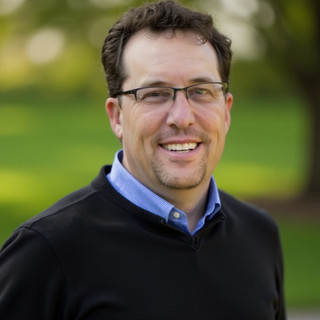
What a World Record Runner Taught Me About Truly Seeing People - Brad Barton
- kneetoknee
- Mar 5
- 4 min read
I've had a lot of great conversations on KneeToKnee, but every once in a while someone sits

down with me and I walk away genuinely different. That's what happened when Brad Barton joined me.
I've known Brad for close to 20 years. We crossed paths through the National Speakers Association, and I'd always known he was an exceptional human being. But sitting down with him on the podcast — really talking — reminded me why I started this show in the first place.
Brad grew up on a cattle ranch near Salmon, Idaho. Not exactly the origin story you'd predict for someone who would go on to break a 30-year-old masters world track record, speak at NASA and the Mayo Clinic, and develop into one of the most respected executive coaches and keynote speakers in the country. But that's the thing about Brad — nothing about his path was supposed to work out the way it did.
The only Division I program that recruited him was Weber State University. His coach there, Chick Hislop — an NCAA Hall of Famer who would later serve as the US Olympic distance coach in Atlanta — looked past the raw numbers and saw something in a scrappy, unpolished kid from a cattle ranch. That belief changed everything.
Brad went on to compete at the Olympic trials. He came up short — slipping in the semi-finals when a spot in Barcelona seemed within reach, then ripping something in his hip before Atlanta. And for a while, that was that. He raised a family. He felt called to speak. He spent a decade building that career.
Then one day at a high school track meet, he watched a group of older men run what he later found out was the 'coach's mile.' Something stirred in him. He called Coach Hislop — the same man who had believed him into his best athletic years — and together they set their sights on something that seemed almost laughable: a masters world record in the mile. The existing record had stood for 30 years. Brad was 45.
They failed. A lot. And then, at 47, he ran a 4:16. A world record. And then another.
What struck me most wasn't the record itself. It was what Brad said about how it happened. He didn't talk about talent. He talked about his coach. He talked about a man who looked at an aging body and said, 'Or maybe it can be done and we just haven't figured it out yet.' He talked about a mentor who gave him one simple piece of advice that changed everything:
Don't make a thousand hard decisions. Make one big decision to do all the things it takes — and then just do them.
That hit me. Because how often do we re-decide? We decide we're going to get healthy, and then we have to decide again every morning when the alarm goes off. We decide we're going to invest in our relationships, and then we have to decide again when we're tired. Brad's coach short-circuited all of that with one simple, almost philosophical reframe.
The other thing Brad shared that I keep coming back to was his 'Touch the Road' rule. On the days when he didn't feel like training, his only obligation was to go outside and touch the road. That was it. He said in all those years of record-breaking training, he can only remember not completing a workout after touching the road twice. Every other time, once his shoes hit the road, he ran.
We spend so much energy trying to manufacture motivation. But sometimes you just need a low enough threshold to get moving.
Brad also talked about where we are right now — this era of artificial intelligence and rapid change — and made a point that I think is one of the most important things I've heard on this podcast. As technology becomes more integrated into our lives, human connection doesn't become less important. It becomes more important. And yet we're moving in the opposite direction. We've surrounded ourselves with tools designed to connect us, and somehow we're more isolated than ever.
He ended our conversation with what he called his 'I See You' challenge — borrowed from a scene in the movie Avatar. Instead of the hollow 'Hi, how are you? Fine, you?' exchange that passes for connection in most of our days, Brad challenges people to actually see whoever is in front of them. Ask the drive-through worker their name. Tell them they have a hard job. Make eye contact. Have a human moment.
It sounds simple. It is simple. But Brad told me about a hospital leadership team that took this idea seriously — making it part of their daily huddles, asking who had the 'I See You story' — and their patient satisfaction scores went through the roof. The parent company called and said: what are you doing down there?
They were seeing people.
That's the heart of KneeToKnee. Getting down on the same level as another person. Looking them in the eye. Closing the distance — literally and figuratively.
Brad and I barely scratched the surface. I'm already planning to have him back. In the meantime, I hope you'll take a few minutes to listen to the full conversation. I think it'll leave you thinking about connection differently.
Listen here: https://youtu.be/C5DPsgEqpJo


Comments